
Our 2nd edition of the Spaces series is definitely an interesting one. Many reading now may be thinking “Why did they interview a priest?”, but priesthood and religion play a bigger part in most people’s lives than one may at first think. Father Paschal Uche is a catholic priest ordained just 3 years ago and is someone who inspires a new generation of young people by redefining the everchanging perception of tradition in today’s society. I’m someone who’s always been fascinated by religion and its effect on different societies so when Pierre mentioned the idea of interviewing Paschal, we just knew it was something we had to do to gain a deeper understanding of Catholicism and the long-lasting effects its left on a myriad of cultures. So sit back, relax and get a deeper insight into the perspective of Father Paschal.
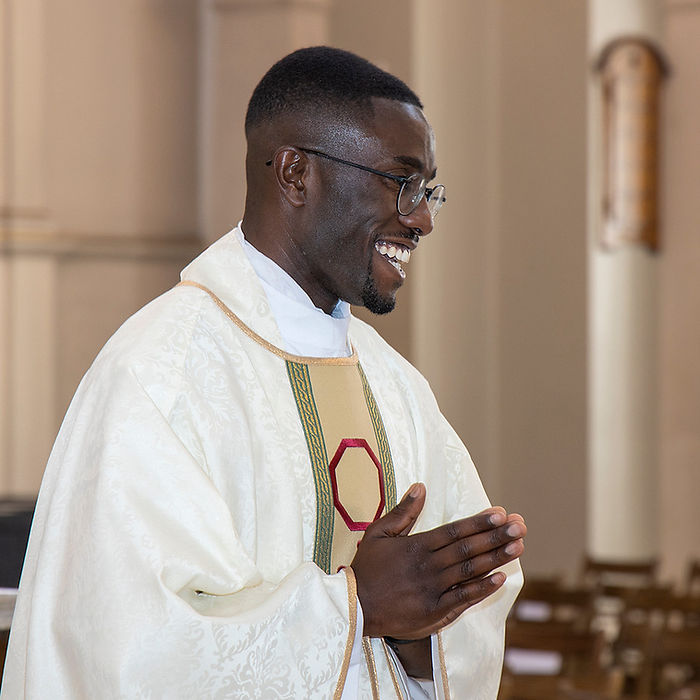
So Father, would you be able to give us a short description of your role, your background etc..?
“Of course. I’m a catholic priest that lives and works in Colchester. The role of a catholic priest involves ‘in persona Christi’, meaning we bring Christ to the people in a very real way by the preaching of God’s word, bringing the sacraments, being with people and being a witness to Jesus wherever we are.”
Talk to me about priesthood, was it something you always wanted to do? How did you get into it?
“I didn’t always want to be a priest, but in my late teens when things were quite difficult it gave me an opportunity to lean into God and to see what was really important in my life.”
“My prayer life grew and through various things it was a real sense of invitation towards the priesthood which made me really excited with a sense of being fulfilled by following that path. Through 6 years of seminary I was able to discern that call and then 3 years ago on the 1st of August I was ordained a priest and I’ve never looked back since.”
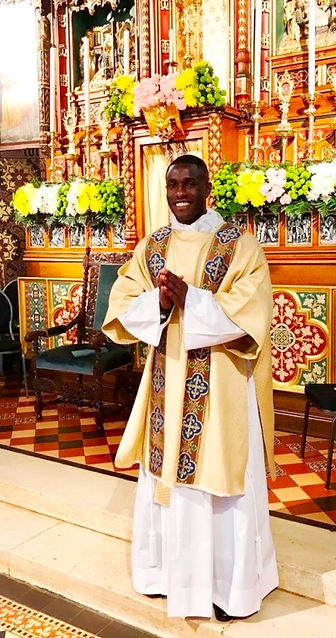
“Culturally, I think we had a really strong foundation of faith and an atmosphere of prayer which paved the way for deeper experiences in my life as I began to own the faith journey a bit more and began to hear and follow God more personally for myself, so I’m grateful to my parents & their faith which has sprung out of their culture as well because that’s been really important to me.”
Talk to me about culture. How important is it in your life and how does it impact you?
“I think it comes from a place of knowing that God has created me as I am, and everything about me culturally, my race, my history, etc. and so by knowing that I can best express his goodness in the world. I go about in Colchester just dressed as a priest and I feel a great joy in doing that because there’s not many young black priests you know. I think in the Catholic faith that’s what ‘Catholic’ means; it’s supposed to be a place where every race and ethnicity can feel at home and so I definitely feel a sense of responsibility and privilege of living that out even as I still discover. The more I discover about my heritage & my culture, my faith is a place in which I can express that, not just sort of as one more expression, but as something of God’s beauty in the world. And so I feel like I live that out and I’m still discovering how best to do that and what it really means.”
Would you say there’s extra responsibility bestowed upon you being a young black priest in the UK?
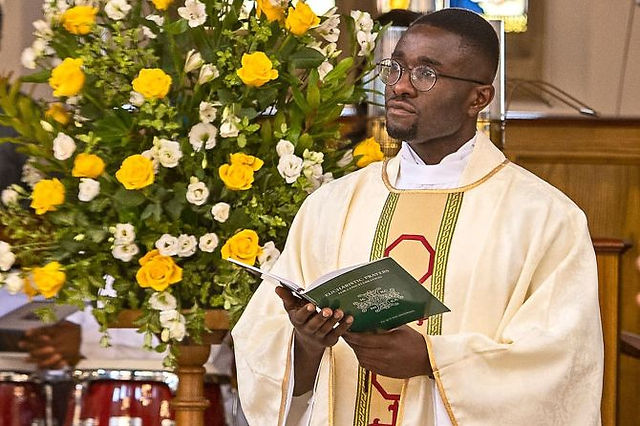
“Yeah, I think so, but St John Paul II talked about gift and responsibility and when you receive a gift, there’s an equal responsibility that goes with that. I see my culture, my heritage, and my identity as a real gift and there’s a responsibility of living that out well to free other people to be able to live out their own realities.
Because of this I never see myself just as being an advocate for people who look like me or who are like me, but by doing that well and joyfully hopefully, other people feel like ‘Do you know what…I could walk down a particular path I think God’s calling me to walk down!’ Even though I might not see many people who look like me, I feel like there is a responsibility but as I mentioned, it’s an opportunity to receive a great gift.”
As a priest, you meet a lot of people…has experiencing other cultures helped you understand your own or would you even say you’ve had to dig deeper into your own culture to appreciate other peoples’?
“It’s a bit of both. I feel very privileged in the place I’m in Colchester and as a Catholic. The majority of races in the church are Polish, Filipino etc. and I see how they live and practice their faith and I can see that and use it as a bit of a reference and go “Ok, what’s my experiences been like? Where do I feel like we could grow in ways, and what’s inspiring about what they do?” So I guess it’s part of a great melting pot of different cultures.”
“Somebody once put it like this, they don’t want it to be a smoothie where everything is blended into one but rather like a fruit salad where we all have our distinct cultures. I think that’s the model; identify what we do that’s unique and bring that to the world.”
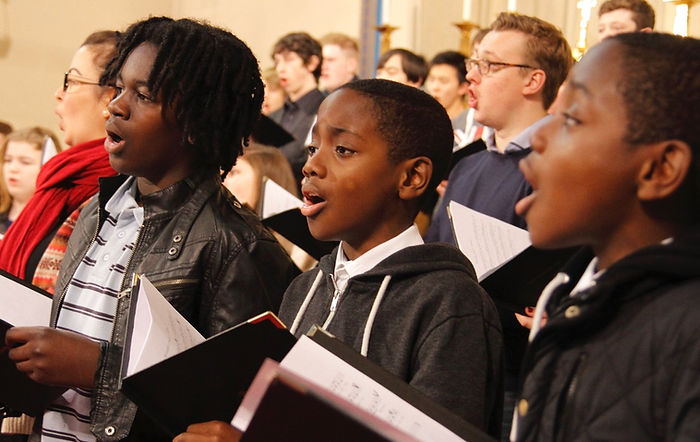
An example would be when it comes to the liturgy, music and worship that’s something that we do very well, so I’ve brought at least once an African choir to my parish and people were really wowed by it and enjoyed it and were blessed by it. So it’s about being able to recognise what we bring to the conversation that enriches the whole.”
Would you say that being black is always ingrained in your mind?
In part it’s dependent. I’m probably more aware of being a catholic priest in terms of being different at home. If I go abroad and it’s predominately white then that’s something I’m probably more conscious of but to be conscious of is not being uncomfortable with. So I’m conscious of it but as I grow and appreciate who I am and I’m more secure in who I am I can be conscious and still comfortable, at least that’s the hope. I think that’s God’s desire for me which is the case. A good example is priest meetings and whatever else, there wouldn’t be many black priests maybe in my deanery, so I could be conscious but comfortable.
THE COME UP // WHERE PASCHAL BEGAN
“I started in Stratford, then moved out further east to Wanstead, then went to Nottingham to study Pharmacy and then to Birmingham. It’s been really interesting culturally going to places like Nottingham and Birmingham and seeing what the black communities there are like in certain ways and yeah to be able to appreciate the differences there and also the similarities.”
“I think it can be a challenge for us to not go in thinking that we already know it & to be able to appreciate the differences and be open to that and not to see differences as barriers. I didn’t really get to know much of the black community in Nottingham because I was just a student but for example in Birmingham, I got to know some people while I was a seminarian and it’s really fun and interesting to go into these different spaces with a perspective that’s like, I can appreciate something new here and not be intimidated. If you come out of the black community you know not to be intimidated by that but there’s something new for me to pick up and also something for you to bring and I think if you have those kinds of things in your mind then you’re probably in a better place.”
Would you say that being a priest has allowed you to meet a lot of different people you wouldn’t necessarily meet if you weren’t?
“Definitely, I think the nature of priesthood is like that. I remember when I was studying for priesthood there was a beautiful video called Fishers of Men and there was an East African priest who said, ‘Wherever there is a human need, a Catholic priesthood is meaningful’, and I’ve always had that ringing in my heart really.
I remember times getting called out to hospital, might be a white family, an Asian family etc. but because you’re a priest, that’s all that truly matters, that you’re going to bring the sacraments to their loved one before they die. I have no experience where that’s been an issue. I see people that have a need for Christ, I come and they’ve been able to reach out to him.
So yeah, that’s been my experience. I’ve been quite privileged to have that unique perspective where I get invited to the most intimate moments of people’s lives and get to experience their culture but bring a part of my own and I hope that I’m able to share that with parishes and groups in the future.”
“I sing a lot which has come out of my experience. I bring that to my preaching and at the times when I meet people, that’s something that God has given me and I think it’s important for the short time that we have here to share that and that’s how I kind of see it so culturally even the conversation now helps me to think how that’s just part of what I bring.”
Lastly, If you had advice for anyone who may be struggling in a community right now, what advice would you give them in terms of navigating that space?
“Recognise that there’s a blessing in that space because it gives them an opportunity to make a deeper journey. If you’re put into a particular more difficult place or period of life, that gives you an opportunity to do a bit of deeper more profound journeying into who you are and that’s the stuff that makes us. So I’d say don’t try and escape it but in some ways, if you’re religious, try and understand what God is saying and ask yourself if you’re inviting God into that space. If you’re not a religious person, try and ask yourself, ‘What is being said at this moment that can help me to grow?’. So yeah, I’d not try to escape it as the world might tell us to, I’d say actually, there’s some blessing in that for you to experience in this period of your life and you’ll come out stronger so yeah, hold on in.”
– interview performed, curated and paraphrased by Laolu Fayokun on 31/07/23. Rereleased on 25/01/25
 raise a voice
Leave a comment